can markets send us signals that allow us to know what might happen to the economy?
In contract theory, signalling (or signaling; run across spelling differences) is the idea that one party (termed the agent) credibly conveys some information well-nigh itself to another party (the principal). Although signalling theory was initially developed by Michael Spence based on observed knowledge gaps between organisations and prospective employees,[ane] its intuitive nature led it to be adapted to many other domains, such as Human being Resource Direction, business, and financial markets.[ii]
In Spence's job-marketplace signaling model, (potential) employees send a signal about their ability level to the employer by acquiring education credentials. The informational value of the credential comes from the fact that the employer believes the credential is positively correlated with having the greater power and difficulty for depression power employees to obtain. Thus the credential enables the employer to reliably distinguish depression ability workers from loftier ability workers.[1] The concept of signaling is also applicative in competitive donating interaction, where the capacity of the receiving political party is limited.[3]
Introductory questions [edit]
Signalling started with the idea of disproportionate information (a departure from perfect information), which relates to the fact that, in some economical transactions, inequalities exist in the normal market place for the exchange of goods and services. In his seminal 1973 article, Michael Spence proposed that two parties could get around the trouble of disproportionate information past having ane party send a signal that would reveal some slice of relevant information to the other political party.[1] That party would and then interpret the signal and adjust his or her purchasing behaviour accordingly—usually past offer a higher cost than if she had not received the betoken. There are, of course, many problems that these parties would immediately run into.
- Endeavor: How much time, energy, or money should the sender (amanuensis) spend on sending the signal?
- Reliability: How can the receiver (the principal, who is normally the buyer in the transaction) trust the signal to exist an honest declaration of information?
- Stability: Assuming in that location is a signalling equilibrium under which the sender signals honestly and the receiver trusts that data, under what circumstances will that equilibrium suspension down?
Job-market signalling [edit]
In the chore market, potential employees seek to sell their services to employers for some wage, or price. Mostly, employers are willing to pay higher wages to employ meliorate workers. While the individual may know his or her own level of ability, the hiring firm is not (usually) able to discover such an intangible trait—thus in that location is an asymmetry of information between the two parties. Education credentials can be used equally a point to the business firm, indicating a sure level of ability that the individual may possess; thereby narrowing the advisory gap. This is beneficial to both parties every bit long as the signal indicates a desirable attribute—a signal such as a criminal record may not be and so desirable.
Spence 1973: "Chore Market Signaling" paper [edit]
Assumptions and background [edit]
Michael Spence considers hiring every bit a type of investment under doubtfulness[i] analogous to buying a lottery ticket and refers to the attributes of an bidder which are observable to the employer as indices. Of these, attributes which the applicant tin can manipulate are termed signals.[ clarification needed ] Applicant historic period is thus an index only is non a indicate since information technology does non change at the discretion of the bidder. The employer is supposed to have provisional probability assessments of productive capacity, based on previous experience of the market, for each combination of indices and signals.[ description needed ] The employer updates those assessments upon observing each employee's characteristics. The paper is concerned with a risk-neutral employer. The offered wage is the expected marginal product. Signals may be acquired by sustaining signalling costs (budgetary and not). If everyone invests in the indicate in the exactly the same way, then the bespeak can't exist used equally discriminatory, therefore a disquisitional supposition is made: the costs of signalling are negatively correlated with productivity. This situation as described is a feedback loop: the employer updates his beliefs upon new market information and updates the wage schedule, applicants react by signalling, and recruitment takes place. Michael Spence studies the signalling equilibrium that may result from such a state of affairs. He began his 1973 model with a hypothetical example:[ane] suppose that there are 2 types of employees—good and bad—and that employers are willing to pay a higher wage to the good type than the bad type. Spence assumes that for employers, there's no real way to tell in advance which employees will exist of the expert or bad blazon. Bad employees aren't upset about this, considering they become a free ride from the hard work of the expert employees. But skillful employees know that they deserve to be paid more for their higher productivity, so they want to invest in the indicate—in this example, some amount of education. But he does brand ane key assumption: skilful-type employees pay less for i unit of measurement of education than bad-blazon employees. The cost he refers to is not necessarily the price of tuition and living expenses, sometimes called out of pocket expenses, every bit one could make the argument that college ability persons tend to enroll in "better" (i.eastward. more expensive) institutions. Rather, the cost Spence is referring to is the opportunity cost. This is a combination of 'costs', monetary and otherwise, including psychological, time, effort and and so on. Of key importance to the value of the signal is the differing cost structure between "practiced" and "bad" workers. The cost of obtaining identical credentials is strictly lower for the "good" employee than it is for the "bad" employee. The differing cost structure need not foreclose "bad" workers from obtaining the credential. All that is necessary for the bespeak to have value (informational or otherwise) is that the grouping with the signal is positively correlated with the previously unobservable group of "good" workers. In full general, the caste to which a signal is thought to be correlated to unknown or unobservable attributes is direct related to its value.
The result [edit]
Spence discovered that fifty-fifty if instruction did not contribute annihilation to an employee'southward productivity, it could nonetheless have value to both the employer and employee. If the advisable toll/benefit construction exists (or is created), "good" employees will buy more than education in social club to signal their higher productivity.
The increase in wages associated with obtaining a college credential is sometimes referred to as the "sheepskin effect",[four] since "sheepskin" informally denotes a diploma. It is important to note that this is not the same as the returns from an boosted twelvemonth of education. The "sheepskin" effect is actually the wage increase higher up what would commonly be attributed to the extra year of instruction. This can exist observed empirically in the wage differences between 'drop-outs' vs. 'completers' with an equal number of years of pedagogy. Information technology is as well important that 1 does non equate the fact that higher wages are paid to more educated individuals entirely to signalling or the 'sheepskin' furnishings. In reality, instruction serves many different purposes for individuals and society equally a whole. Only when all of these aspects, equally well as all the many factors affecting wages, are controlled for, does the effect of the "sheepskin" approach its true value. Empirical studies of signalling betoken it equally a statistically significant determinant of wages, however, it is one of a host of other attributes—age, sex, and geography are examples of other important factors.
The model [edit]
To illustrate his argument, Spence imagines, for simplicity, two productively distinct groups in a population facing ane employer. The bespeak under consideration is education, measured by an index y and is subject field to individual choice. Teaching costs are both budgetary and psychic. The data can be summarized every bit:
| Group | Marginal Product | Proportion of population | Toll of education level y |
|---|---|---|---|
| I | one | y | |
| Two | 2 | y/2 |


Suppose that the employer believes that there is a level of education y* below which productivity is 1 and to a higher place which productivity is ii. His offered wage schedule Westward(y) volition be:
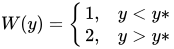
Working with these hypotheses Spence shows that:
- There is no rational reason for someone choosing a dissimilar level of pedagogy from 0 or y*.
- Group I sets y=0 if ane>ii-y*, that is if the render for not investing in didactics is higher than investing in education.
- Group II sets y=y* if 2-y*/2>1, that is the return for investing in pedagogy is higher than not investing in pedagogy.
- Therefore, putting the previous 2 inequalities together, if 1<y*<ii, then the employer's initial beliefs are confirmed.
- There are infinite equilibrium values of y* belonging to the interval [1,2], but they are not equivalent from the welfare betoken of view. The higher y* the worse off is Group 2, while Group I is unaffected.
- If no signaling takes place each person is paid his unconditional expected marginal product . Therefore, Grouping, I is worse off when signaling is present.

In conclusion, even if education has no real contribution to the marginal product of the worker, the combination of the beliefs of the employer and the presence of signalling transforms the education level y* in a prerequisite for the college paying chore. It may appear to an external observer that teaching has raised the marginal production of labor, without this necessarily existence true.
Some other model [edit]
For a indicate to be effective, certain conditions must be truthful. In equilibrium, the price of obtaining the credential must be lower for high productivity workers and human activity as a signal to the employer such that they will pay a higher wage.

In this model it is optimal for the higher ability person to obtain the credential (the observable signal) but non for the lower ability private. The table shows the outcome of low ability person l and loftier ability person h with and without signal S* :
| Person | Without Signal | With Betoken | Will the person obtain the signal S* ? |
|---|---|---|---|
| l | Wo | West* - C'(l) | No, considering Westo > W* - C'(l) |
| h | Westwardo | W* - C'(h) | Yep, because Wo < W* - C'(h) |
The structure is as follows: There are 2 individuals with differing abilities (productivity) levels.
- A higher ability / productivity person: h
- A lower ability / productivity person : fifty
The premise for the model is that a person of loftier ability (h) has a lower toll for obtaining a given level of education than does a person of lower ability (l). Toll tin be in terms of monetary, such as tuition, or psychological, stress incurred to obtain the credential.
- Wo is the expected wage for an education level less than South*
- Due west* is the expected wage for an education level equal or greater than S*
For the individual:
- Person(credential) - Person(no credential) ≥ Cost(credential) → Obtain credential
- Person(credential) - Person(no credential) < Toll(credential) → Do not obtain credential
Thus, if both individuals act rationally information technology is optimal for person h to obtain S* but non for person l and then long as the following weather condition are satisfied.
Edit: note that this is incorrect with the example as graphed. Both 'fifty' and 'h' have lower costs than W* at the education level. Also, Person(credential) and Person(no credential) are non clear.
Edit: note that this is ok as for depression blazon "50": , and thus low type will cull Exercise not obtain credential.

Edit: For there to exist a separating equilibrium the loftier type 'h' must besides check their outside selection; do they want to choose the cyberspace pay in the separating equilibrium (calculated above) over the cyberspace pay in the pooling equilibrium. Thus we also need to examination that: Otherwise loftier type 'h' volition cull Exercise non obtain credential of the pooling equilibrium.

For the employers:
- Person(credential) = East (Productivity | Cost(credential) ≤ Person(credential) - Person(no credential) )
- Person(no credential) = East (Productivity | Cost(credential) > Person(credential) - Person(no credential) )
In equilibrium, in order for the signalling model to hold, the employer must recognize the signal and pay the corresponding wage and this volition event in the workers self-sorting into the 2 groups. One can encounter that the cost/do good structure for a signal to exist effective must fall within certain bounds or else the system will neglect.[5]
IPOs [edit]
Leland and Pyle (1977) analyze the role of signals within the process of IPO. The authors show how companies with good future perspectives and higher possibilities of success ("good companies") should always send articulate signals to the market place when going public; the possessor should go along control of a pregnant percentage of the company. To be reliable, the betoken must be besides costly to be imitated by "bad companies". If no point is sent to the market, asymmetric data volition result in adverse pick in the IPO market.
Brands [edit]
Waldfogel and Chen (2006)[6] demonstrate the importance of brands in signalling quality in online marketplaces.
eBay Motors' Price Premium [edit]
Signalling has been studied and proposed as a means to address asymmetric data in markets for "lemons".[seven] Recently, signalling theory has been practical in used cars market such as eBay Motors. Lewis (2011)[eight] examines the function of information access and shows that the voluntary disclosure of private information increases the prices of used cars on eBay. Dimoka et al. (2012)[9] analyzed data from eBay Motors on the role of signals to mitigate production uncertainty. Extending the data disproportion literature in consumer behavior literature from the agent (seller) to the product, authors theorized and validated the nature and dimensions of production dubiousness, which is distinct from, yet shaped past, seller uncertainty. Authors likewise found information signals (diagnostic product descriptions and third-party product assurances) to reduce product uncertainty, which negatively touch on toll premiums (relative to the book values) of the used cars in online used cars markets.
Internet-Based Hospitality Exchange [edit]
In internet-based hospitality commutation networks such as BeWelcome and Warm Showers, hosts do non expect to receive payments from travelers. The relation between traveler and host is rather shaped by mutual altruism. Travelers send homestay requests to the hosts, which the hosts are not obligated to take. Both networks as non-profit organizations grant trustworthy teams of scientists access to their anonymized data for publication of insights to the benefit of humanity. In 2015, datasets from BeWelcome and Warm Showers were analyzed.[10] Analysis of 97,915 homestay requests from BeWelcome and 285,444 homestay requests from Warm Showers showed general regularity — the less fourth dimension is spent on writing a homestay asking, the less is the probability of being accepted by a host. Low-effort communication aka 'copy and paste requests' obviously sends the wrong signal.[10]
Outside options [edit]
Most signalling models are plagued past a multiplicity of possible equilibrium outcomes.[11] In a written report published in the Journal of Economical Theory, a signalling model has been proposed that has a unique equilibrium outcome.[12] In the main-agent model it is argued that an amanuensis volition cull a large (observable) investment level when he has a strong outside option. All the same, an agent with a weak outside pick might attempt to bluff by also choosing a big investment, in order to make the primary believe that the agent has a strong exterior selection (so that the main volition make a amend contract offer to the agent). Hence, when an agent has private information about his outside choice, signalling may mitigate the concur-up problem.
Foreign policy and international relations [edit]
Due to the nature of international relations and foreign policy, signaling has long been a topic of interest when analyzing the actions of the agents involved. This study of signaling regarding strange policy has further allowed economists and academics to empathise the actions and reactions of strange bodies when presented with varying data. Typically when interacting with 1 another, the actions of these foreign parties are heavily dependent on the proposed actions and reactions of each other.[xiii] In many cases however, in that location is an asymmetry of information between the two parties with both looking to aid their own not-mutually beneficial interests.
Costly signaling [edit]
In foreign policy, it is mutual to come across game theory problems such as the prisoner's dilemma and chicken game occur every bit the different parties both have a dominating strategy regardless of the actions of the other party. In society to signal to the other parties, and furthermore for the signal to be credible, strategies such every bit tying hands and sinking costs are often implemented. These are examples of costly signals which typically present some grade of balls and commitment in lodge to show that the signal is apparent and the political party receiving the signal should human action on the information given.[thirteen] Despite this however, in that location is still much contention as to whether, in practice, costly signaling is effective. In studies by Quek (2016) it was suggested that decision makers such as politicians and leader don't seem to interpret and understand signals the way they that models suggest they should.[14]
| B Cooperate | B Defect | |
|---|---|---|
| A Cooperate | iii,three | 0,v |
| A Defect | 5,0 | i,one |
| B Swerve | B Don't Serve | |
|---|---|---|
| A Swerve | 0,0 | -1,1 |
| A Don't Swerve | 1,-one | -5,-5 |
Sinking costs and Tying hands [edit]
A costly indicate in which the cost of an action is incurred upfront ("ex dues") is a sunk cost. An example of this would be the mobilization of an ground forces as this sends a clear betoken of intentions and the costs are incurred immediately.
When the cost of the action is incurred later on the decision is fabricated ("ex mail") it is considered to be tying easily. A common example is an brotherhood which does not have a big initial monetary cost yet ties the easily of the parties, as they are now reliant on each other in a fourth dimension of crunch.
Theoretically both sinking costs and tying easily are valid forms of costly signaling nevertheless they accept garnered much criticism due to differing behavior regarding the overall effectiveness of the methods in altering the likelihood of war. Recent studies such every bit the Journal of Conflict Resolution suggest that sinking costs and tying hands are both effective in increasing credibility. This was washed past finding how the change in the costs of costly signals vary their credibility. Prior to this research studies conducted were binary and static by nature, limiting the adequacy of the model.[15] This increased the validity of the use of these signaling mechanisms in foreign affairs.
Effectiveness of signaling through time [edit]
The initial inquiry into signaling suggested that it was an effective tool in order to manage foreign economic and armed services affairs however, with time and more than thorough analysis problems began to present themselves, these being:
- Whether or not the extent to which the signal is received and acted upon may non justify the cost of the signal
- Parties and those who govern them are able to signal in more ways than only through actions
- Different signals often provoke unlike responses from different parties (heterogeneity plays a big part in the effectiveness of signals)[13]
In Fearon's original models (Bargaining model of state of war) the model was elementary in that a party would display their intentions, their intended audition would then interpret the signals and act upon them. Thus, creating a perfect scenario which validates the use of signaling. After in works by Slantchev (2005), it was suggested that due to the nature of using war machine mobilization as a signal, despite having intentions to avoid war can increase tensions and thus both exist a sunk cost and can tie the party's hands. Furthermore Yarhi-Milo, Kertzer and Renshon (2017) were able to use a more dynamic model to assess the effectiveness of these signals given varying toll levels and reaction levels.[fourteen]
See also [edit]
- Countersignalling
- Forward guidance
- Impression management
- Signalling game
- Stigma direction
- Virtue signalling
- Handicap Principle
References [edit]
- ^ a b c d e Michael Spence (1973). "Job Market Signaling". Quarterly Journal of Economics. 87 (iii): 355–374. doi:10.2307/1882010. JSTOR 1882010.
- ^ Connelly, B. Fifty.; Certo, S. T.; Ireland, R. D.; Reutzel, C. R. (2011). "Signaling theory: A review and assessment". Journal of Management. 37 (1): 39–67. doi:10.1177/0149206310388419. S2CID 145334039.
- ^ Lotem, A., Chiliad. Fishman, and Fifty. Stone. 2003. From reciprocity to unconditional altruism through signaling benefits. Proc. R. Soc. Lond. B. 270: 200.
- ^ Hungerford, Thomas; Solon, Gary (1987). "Sheepskin Furnishings in the Returns to Education". Review of Economics and Statistics. 69 (i): 175–177. doi:10.2307/1937919. JSTOR 1937919.
- ^ http://economic science.mit.edu/files/552[ blank URL PDF ]
- ^ Waldfogel, Joel; Chen, 50 (2006). "Does Information Undermine Brand? Information Intermediary Use and Preference for Branded Spider web Retailers". Journal of Industrial Economics. 54 (four): 425–449. CiteSeerXx.i.1.201.155. doi:ten.1111/j.1467-6451.2006.00295.x. S2CID 153526568.
- ^ Akerlof, One thousand. A. (1970). The market for" lemons": Quality dubiety and the market place mechanism. The Quarterly Periodical of Economics, 488-500.
- ^ Lewis, Gregory (2011). "Asymmetric Information, Adverse Selection and Online Disclosure: The Case of eBay Motors". American Economical Review. 101 (4): 1535–1546. CiteSeerX10.one.ane.232.8552. doi:x.1257/aer.101.4.1535.
- ^ Dimoka, Angelika; Hong, Yili; Pavlou, Paul (2012). "On Production Uncertainty in Online Markets: Theory and Evidence". MIS Quarterly. 36 (ii): 395–426. doi:10.2307/41703461. JSTOR 41703461. S2CID 8963257.
- ^ a b Rustam Tagiew; Dmitry I. Ignatov; Radhakrishnan Delhibabu (2015). Economics of Cyberspace-Based Hospitality Exchange. (IEEE/WIC/ACM) International Briefing on Spider web Intelligence and Intelligent Agent Technology (WI-IAT). Singapore. pp. 493–498. arXiv:1501.06941. doi:ten.1109/WI-IAT.2015.89.
- ^ Fudenberg, Drew; Tirole, Jean (1991). Game Theory. MIT Printing.
- ^ Goldlücke, Susanne; Schmitz, Patrick Due west. (2014). "Investments as signals of exterior options". Periodical of Economical Theory. 150: 683–708. doi:ten.1016/j.jet.2013.12.001.
- ^ a b c Gartzke, Erik; Carcelli, Shannon; Gannon, J Andres; Zhang, Jiakun Jack (Baronial 2017). "Signaling in Strange Policy" (PDF). Oxford Research Encyclopedia of Politics: 30.
- ^ a b Yarhi-Milo, Keren; Kertzer, Joshua D; Renshon, Jonathon (2018). "Tying Hands, Sinking Costs and Leader Attributes" (PDF). Journal of Conflict Resolution. 62 (x): 2150–2179. doi:10.1177/0022002718785693. S2CID 150334324 – via Harvard University.
- ^ Quek, Kai (19 January 2021). "Four Costly Signaling Mechanisms". American Political Science Review. 115 (2): 537–549. doi:10.1017/S0003055420001094. S2CID 232422457 – via Cambridge Academy Printing.
Further reading [edit]
- Michael Spence (1973). "Task Market Signaling". Quarterly Journal of Economics. 87 (3): 355–374. doi:10.2307/1882010. JSTOR 1882010. newspaper
- Michael Spence (2002). "Signaling in Retrospect and the Informational Structure of Markets". American Economical Review. 92 (iii): 434–459. doi:10.1257/00028280260136200. (also available as his Nobel Prize lecture PDF)
- Andrew Weiss (1995). "Homo Capital letter vs. Signaling Explanations of Wages". The Periodical of Economic Perspectives. ix (4): 133–154. CiteSeerXten.1.ane.718.3629. doi:x.1257/jep.9.four.133.
- Dimoka, Angelika; Hong, Yili; Pavlou, Paul (June 2012). "On Product Uncertainty in Online Markets: Theory and Bear witness". MIS Quarterly. 36 (2): 395–426. doi:10.2307/41703461. JSTOR 41703461. S2CID 8963257.
- Waldfogel, Joel; Chen, L (2006). "Does Information Undermine Make? Information Intermediary Utilize and Preference for Branded Web Retailers". Periodical of Industrial Economics. 54 (4): 425–449. CiteSeerX10.ane.one.201.155. doi:x.1111/j.1467-6451.2006.00295.x. S2CID 153526568.
- Lewis, Gregory (2011). "Disproportionate Data, Adverse Selection and Online Disclosure: The Case of eBay Motors". American Economical Review. 101 (four): 1535–1546. CiteSeerXx.1.1.232.8552. doi:10.1257/aer.101.iv.1535.
Source: https://en.wikipedia.org/wiki/Signalling_%28economics%29
0 Response to "can markets send us signals that allow us to know what might happen to the economy?"
Postar um comentário